oslab1 进程、线程相关编程实验
操作系统实验lab1
计算机2305 徐国超
1-1进程
1-1-1
代码:
#include <sys/types.h>
#include <stdio.h>
#include <unistd.h>
#include <sys/wait.h>

int main()
{
pid_t pid, pid1;
/* fork a child process */
    pid = fork();
    if (pid < 0) { /* error occurred */
        fprintf(stderr, "Fork Failed");
        return 1;
    }
    else if (pid == 0) { /* child process */
        pid1 = getpid();
        printf("child: pid = %d ",pid); /* A */
        printf("child: pid1 = %d ",pid1); /* B */
    }
    else { /* parent process */
        pid1 = getpid();
        printf("parent: pid = %d ",pid); /* C */
        printf("parent: pid1 = %d ",pid1); /* D */
        wait(NULL);
    }
    return 0;
}
运行结果:
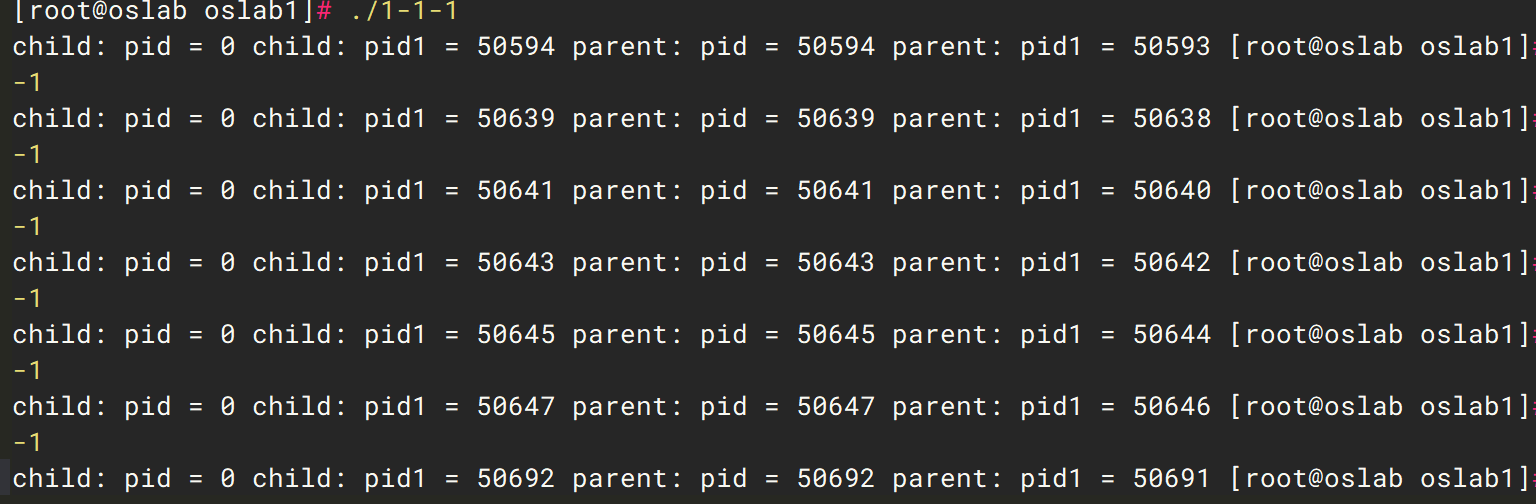
在子进程中 pid=0,执行A B两行代码,输出0和子进程的实际pid
在父进程中 pid=子进程的pid,执行C D两行代码,输出子进程pid和父进程实际pid
1-1-2
去掉wait()后,父进程与子进程执行顺序不确定,多次执行输出如下:
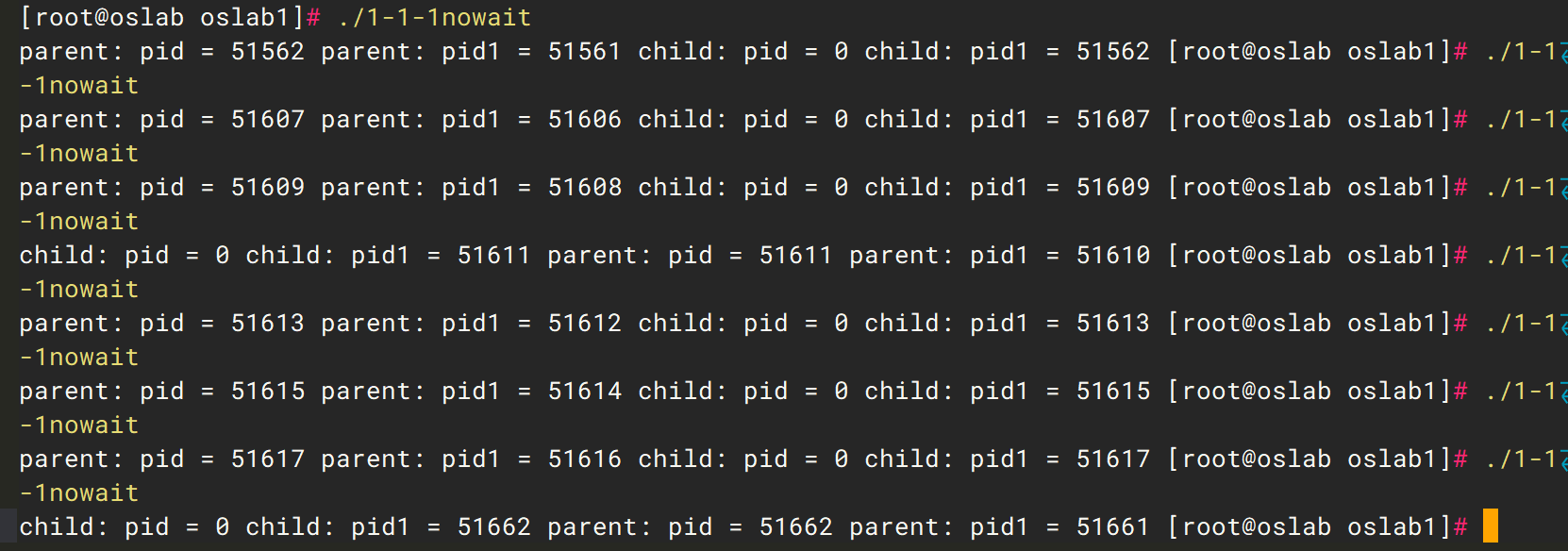
wait()会使父进程执行到该函数时进入阻塞态,子进程执行完毕后再继续执行。
1-1-3
代码:
#include <sys/types.h>
#include <stdio.h>
#include <unistd.h>
#include <sys/wait.h>
#include <stdlib.h>


int global=114514;

int main()
{
    pid_t pid, pid1;

    /* fork a child process */
    pid = fork();

    if (pid < 0) { /* error occurred */
        fprintf(stderr, "Fork Failed");
        return 1;
    }

    else if (pid == 0) { /* child process */
        pid1 = getpid();
        printf("child: pid = %d ",pid); /* A */
        printf("child: pid1 = %d ",pid1); /* B */

        global=1919810;
        printf("child: global = %d\n", global);

        system("echo 'system PID:' $$");

        char *args[] = {"sh", "-c", "echo 'execvp PID:' $$", NULL};
        execvp("sh", args);

        printf("gogogo");
    }

    else { /* parent process */
        pid1 = getpid();
        printf("parent: pid = %d ",pid); /* C */
        printf("parent: pid1 = %d ",pid1); /* D */

        global=0;
        printf("parent: global = %d\n", global);
        wait(NULL);
    }

    global=111111;
    printf("befor return: global = %d\n", global);
    return 0;
}
执行结果:
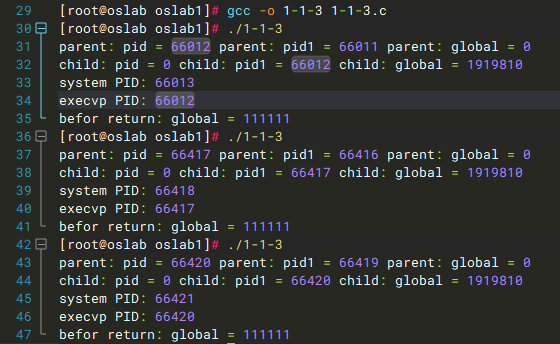
子进程父进程间全局变量不共享,子进程中调用system()创建子进程执行,pid改变,并继续执行后续代码,调用exec()则是直接替换进程,pid不变,后续代码不继续执行。
1-2线程
1-2-1
代码:
#include <stdio.h>
#include <pthread.h>
int share=0;
void* thread1_function(void* arg) {
    for (int i = 0; i < 100000; i++) {
        share += 100;
    }
    printf("线程1完成\n");
    return NULL;
}

void* thread2_function(void* arg) {
    for (int i = 0; i < 100000; i++) {
        share -= 100;
    }
    printf("线程2完成\n");
    return NULL;
}

int main() {
    pthread_t thread1, thread2;

    pthread_create(&thread1, NULL, thread1_function, NULL);
    pthread_create(&thread2, NULL, thread2_function, NULL);

    pthread_join(thread1, NULL);
    pthread_join(thread2, NULL);

    printf("share的值为%d\n", share);
    return 0;
}
执行结果:
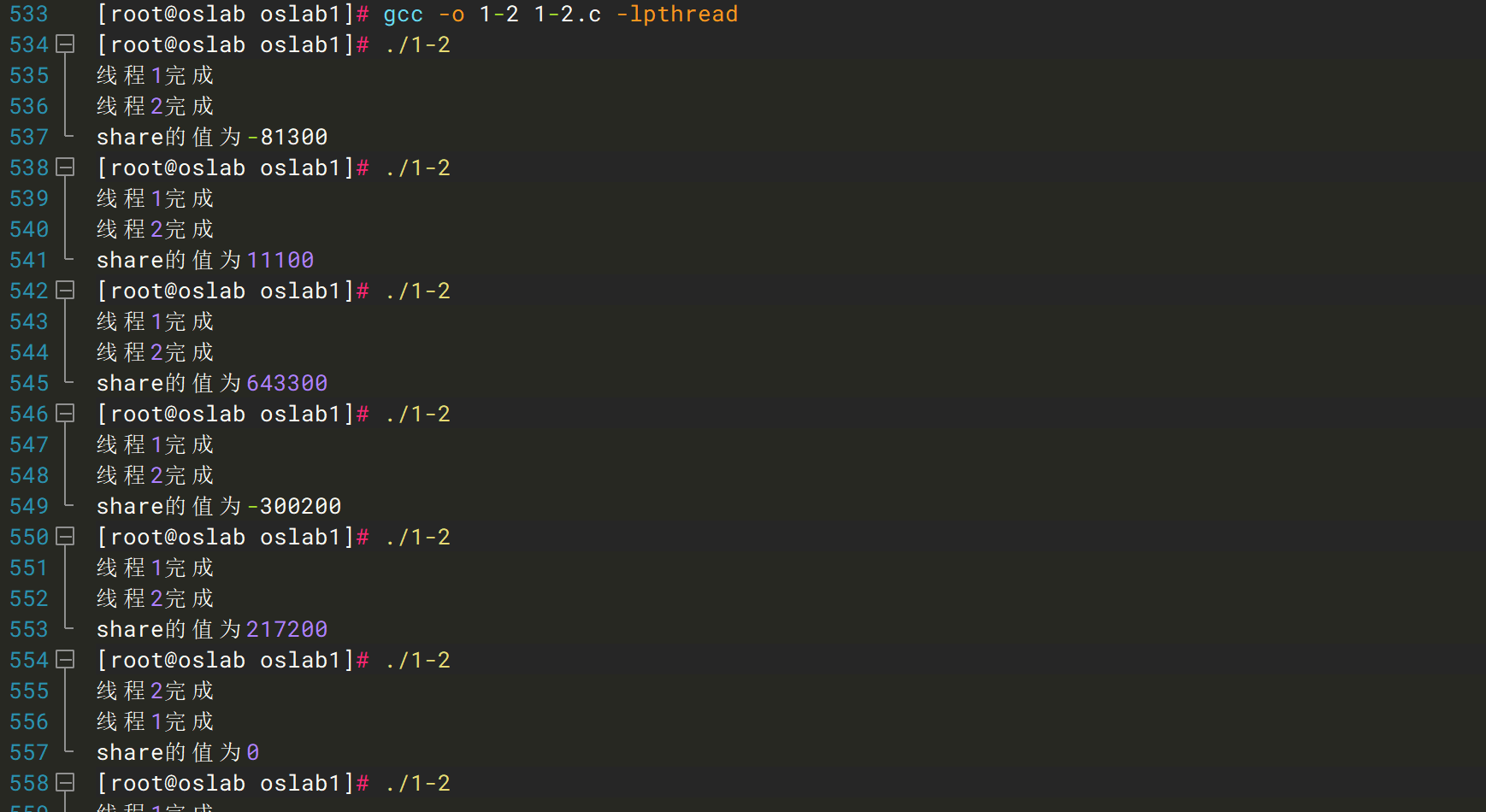
因为share+=100 在寄存器层次上需要多个步骤,例如需要将share加载到寄存器 然后两个线程各对各自寄存器加100,值为100,然后share的值=寄存器,实际只加了100,少了一次
1-2-2
代码:
#include <stdio.h>
#include <pthread.h>
#include<semaphore.h>

int share=0;
sem_t semaphore;

void* thread1_function(void* arg) {
    for (int i = 0; i < 100000; i++) {
        sem_wait(&semaphore);
        share += 100;
        sem_post(&semaphore);
    }
    printf("线程1完成\n");
    return NULL;
}

void* thread2_function(void* arg) {
    for (int i = 0; i < 100000; i++) {
        sem_wait(&semaphore);
        share -= 100;
        sem_post(&semaphore);
    }
    printf("线程2完成\n");
    return NULL;
}

int main() {
    pthread_t thread1, thread2;
    sem_init(&semaphore, 0, 1);
    pthread_create(&thread1, NULL, thread1_function, NULL);
    pthread_create(&thread2, NULL, thread2_function, NULL);

    pthread_join(thread1, NULL);
    pthread_join(thread2, NULL);

    printf("share的值为%d\n", share);
    sem_destroy(&semaphore);
    return 0;
}
执行结果:
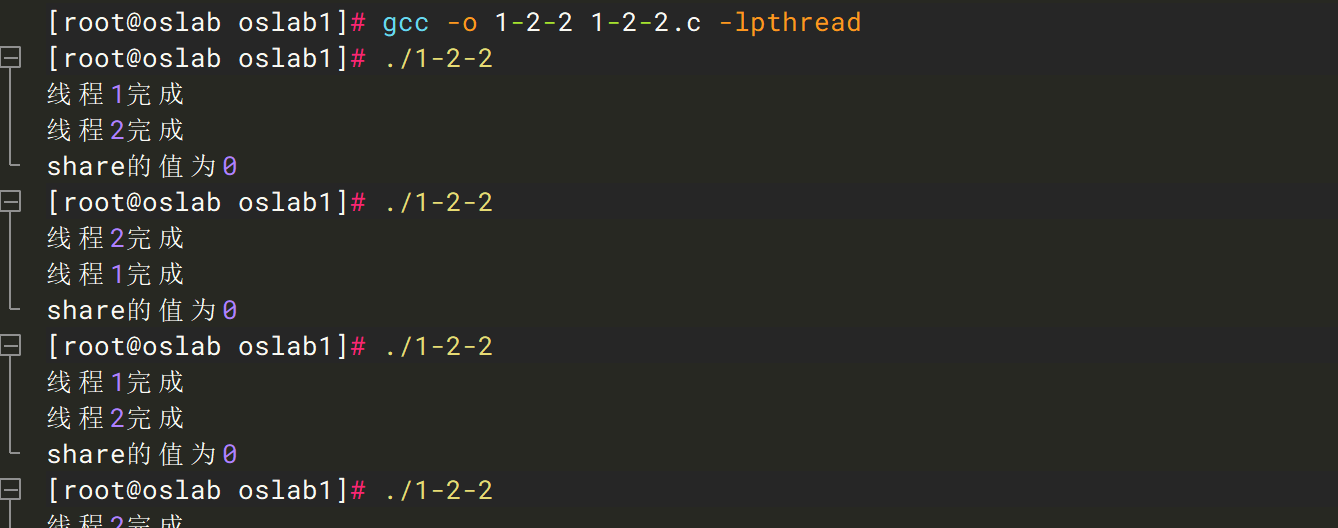
1-2-3s
代码:
#include <stdio.h>
#include <stdlib.h>
#include <unistd.h>
#include <pthread.h>
#include <semaphore.h>
#include <sys/syscall.h>

int share=0;
sem_t semaphore;

void* thread1_function(void* arg) {
    printf("线程1 tid = %d,pid = %d\n", syscall(SYS_gettid), getpid());
    for (int i = 0; i < 100000; i++) {
        sem_wait(&semaphore);
        share += 100;
        sem_post(&semaphore);
    }
    int ret = system("echo 'system call PID:' $$");
    printf("线程1 systemcall return\n");
    printf("线程1完成\n");
    return NULL;
}

void* thread2_function(void* arg) {
    printf("线程2 tid = %d,pid = %d\n", syscall(SYS_gettid), getpid());
    for (int i = 0; i < 100000; i++) {
        sem_wait(&semaphore);
        share -= 100;
        sem_post(&semaphore);
    }
    int ret = system("echo 'system call PID:' $$");
    printf("线程2 systemcall return\n");
    printf("线程2完成\n");
    return NULL;
}

int main() {
    pthread_t thread1, thread2;
    sem_init(&semaphore, 0, 1);
    pthread_create(&thread1, NULL, thread1_function, NULL);
    pthread_create(&thread2, NULL, thread2_function, NULL);

    pthread_join(thread1, NULL);
    pthread_join(thread2, NULL);

    printf("share的值为%d\n", share);
    sem_destroy(&semaphore);
    return 0;
}
执行结果:
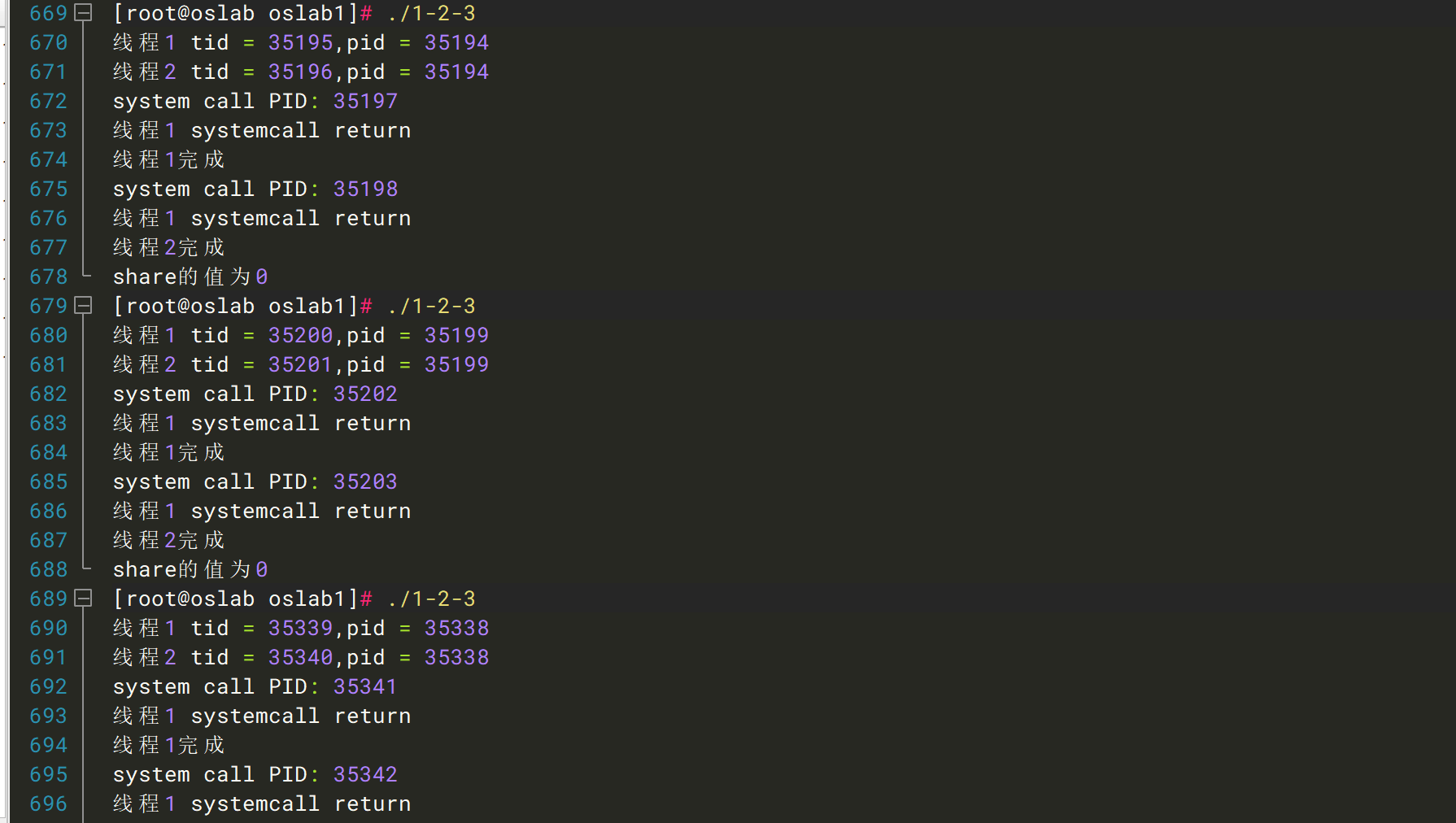
system()创建了子进程。
1-2-3e
代码:
#include <stdio.h>
#include <stdlib.h>
#include <unistd.h>
#include <pthread.h>
#include <semaphore.h>
#include <sys/syscall.h>

int share=0;
sem_t semaphore;

void* thread1_function(void* arg) {
    printf("线程1 tid = %d,pid = %d\n", syscall(SYS_gettid), getpid());
    for (int i = 0; i < 100000; i++) {
        sem_wait(&semaphore);
        share += 100;
        sem_post(&semaphore);
    }
    char *args[] = {"sh", "-c", "echo 'system call PID:' $$", NULL};
    execvp("sh", args);
    printf("线程1 systemcall return\n");
    printf("线程1完成\n");
    return NULL;
}

void* thread2_function(void* arg) {
    printf("线程2 tid = %d,pid = %d\n", syscall(SYS_gettid), getpid());
    for (int i = 0; i < 100000; i++) {
        sem_wait(&semaphore);
        share -= 100;
        sem_post(&semaphore);
    }
    char *args[] = {"sh", "-c", "echo 'system call PID:' $$", NULL};
    execvp("sh", args);
    printf("线程2 systemcall return\n");
    printf("线程2完成\n");
    return NULL;
}

int main() {
    pthread_t thread1, thread2;
    sem_init(&semaphore, 0, 1);
    pthread_create(&thread1, NULL, thread1_function, NULL);
    pthread_create(&thread2, NULL, thread2_function, NULL);

    pthread_join(thread1, NULL);
    pthread_join(thread2, NULL);

    printf("share的值为%d\n", share);
    sem_destroy(&semaphore);
    return 0;
}
执行结果:
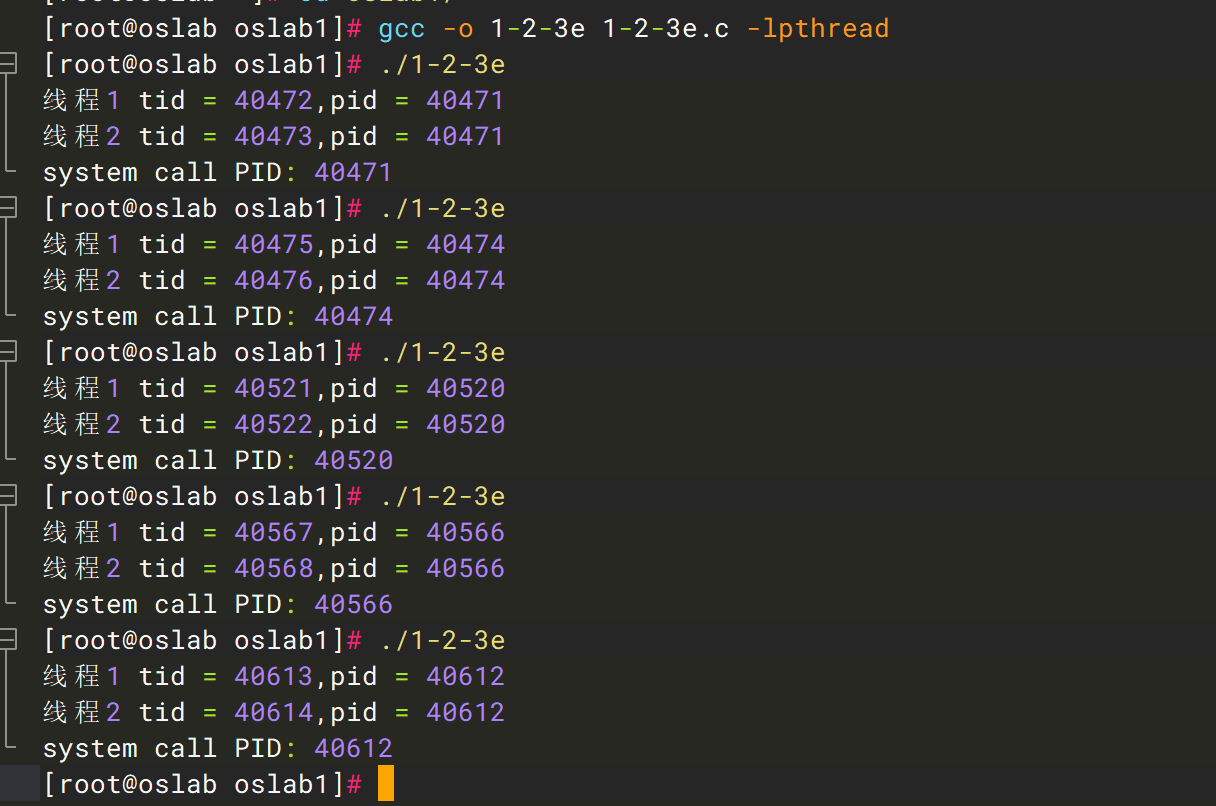
exec()只是替换,没有改变pid。
1-3自旋锁
代码:
#include <stdio.h>
#include <pthread.h>

// 定义自旋锁结构体
typedef struct {
    int flag;
} spinlock_t;

// 初始化自旋锁
void spinlock_init(spinlock_t *lock) {
    lock->flag = 0;
}

// 获取自旋锁
void spinlock_lock(spinlock_t *lock) {
    while (__sync_lock_test_and_set(&lock->flag, 1)) {
        // 自旋等待
    }
}

// 释放自旋锁
void spinlock_unlock(spinlock_t *lock) {
    __sync_lock_release(&lock->flag);
}

// 共享变量
int shared_value = 0;
// 线程函数
void *thread_function(void *arg) {
    spinlock_t *lock = (spinlock_t *)arg;
    for (int i = 0; i < 5000; ++i) {
    spinlock_lock(lock);
    shared_value++;
    spinlock_unlock(lock);
    }
    return NULL;
}
int main() {
    pthread_t thread1, thread2;
    spinlock_t lock;
    // 输出共享变量的值
    printf("初始时shared_value: %d\n", shared_value);
    // 初始化自旋锁
    spinlock_init(&lock);
    // 创建两个线程
    pthread_create(&thread1, NULL, thread_function, (void *)&lock);
    pthread_create(&thread2, NULL, thread_function, (void *)&lock);
    // 等待线程结束
    pthread_join(thread1, NULL);
    pthread_join(thread2, NULL);
    // 输出共享变量的值
    printf("最终时shared_value: %d\n", shared_value);
    return 0;
}
执行结果:
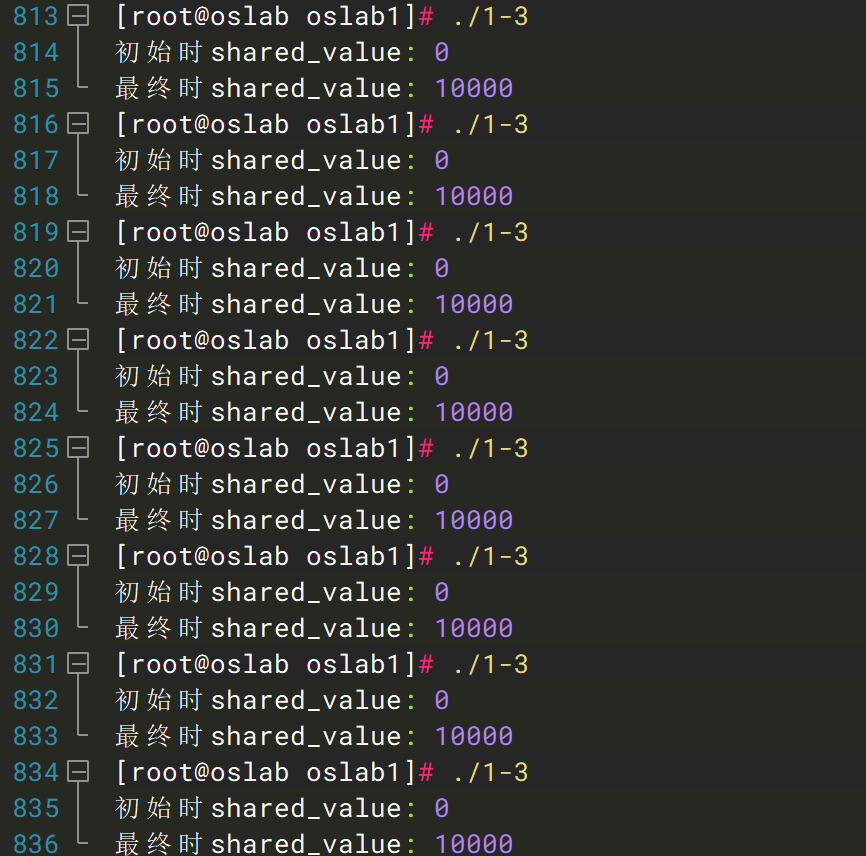
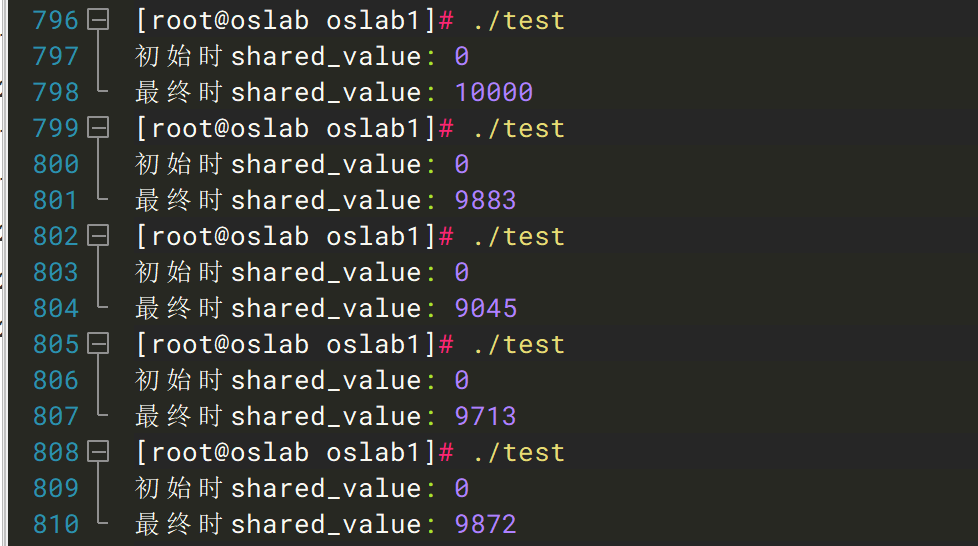
自旋锁可以使某个值在被某个线程修改时让另一个线程等待,等修改完成后设置为空闲,然后另一个线程才可以修改,避免了两个线程同时修改某个值。
如果没有自旋锁?
#include <stdio.h>
#include <pthread.h>
int shared_value = 0;
void *thread_function(void *arg) {
    for (int i = 0; i < 5000; ++i) {
    shared_value++;
    }
    return NULL;
}

int main() {
    pthread_t thread1, thread2;
    // 输出共享变量的值
    printf("初始时shared_value: %d\n", shared_value);
    // 创建两个线程
    pthread_create(&thread1, NULL, thread_function, NULL);
    pthread_create(&thread2, NULL, thread_function, NULL);
    // 等待线程结束
    pthread_join(thread1, NULL);
    pthread_join(thread2, NULL);
    // 输出共享变量的值
    printf("最终时shared_value: %d\n", shared_value);
    return 0;
}